 HelloRemind
Coming Soon
HelloRemindLast updated: November 2026
Text messaging starts once our carrier registration is approved. Until then, HelloRemind reminds people and alerts escalation contacts by phone call only, and sends no texts. The terms below describe exactly how texting works when it starts: nobody receives a text they have not asked for or agreed to in the way described here.
HelloRemind sends transactional text messages to three kinds of people, and asks each of them for consent separately. This page describes exactly how that consent is collected, what the messages say, and how to stop them. It is written to be read without an account, so that anyone — a recipient, a family member, or a mobile carrier reviewing our messaging — can verify what we do. The screenshots show the live product using illustrative data.
We never send marketing or promotional text messages. Creating an account does not by itself enroll anyone in texts. Account holders separately consent during onboarding before entering the caregiver dashboard; consent remains optional for invited caregivers and is never a condition of purchase. We never sell, rent, or share mobile numbers or consent records with third parties or affiliates for their marketing.
Our messages are sent from (404) 341-4998. Every message we send on our own begins with the name HelloRemind, and every one except a one-time phone verification code tells the reader how to stop. Replies to a keyword someone texts us (STOP, START, HELP, DONE or OK) answer the message they just sent. People whose language is set to Spanish receive every message described here in Spanish.
Caregivers — the person who creates an account, or someone they invite to help. They receive status notifications about reminders they set up: whether a reminder was answered or missed. See section 2.
Recipients — the person a caregiver is caring for, who receives the reminders themselves. A recipient does not create an account; their number is entered by their caregiver. Because of that, we ask the recipient directly for their own consent before we ever send them a reminder. See section 3, which is the important one.
Escalation contacts — a family member or neighbour a caregiver nominates to be alerted if a reminder is missed. They never sign up for anything, so we ask them directly too, before any alert is sent. See section 4.
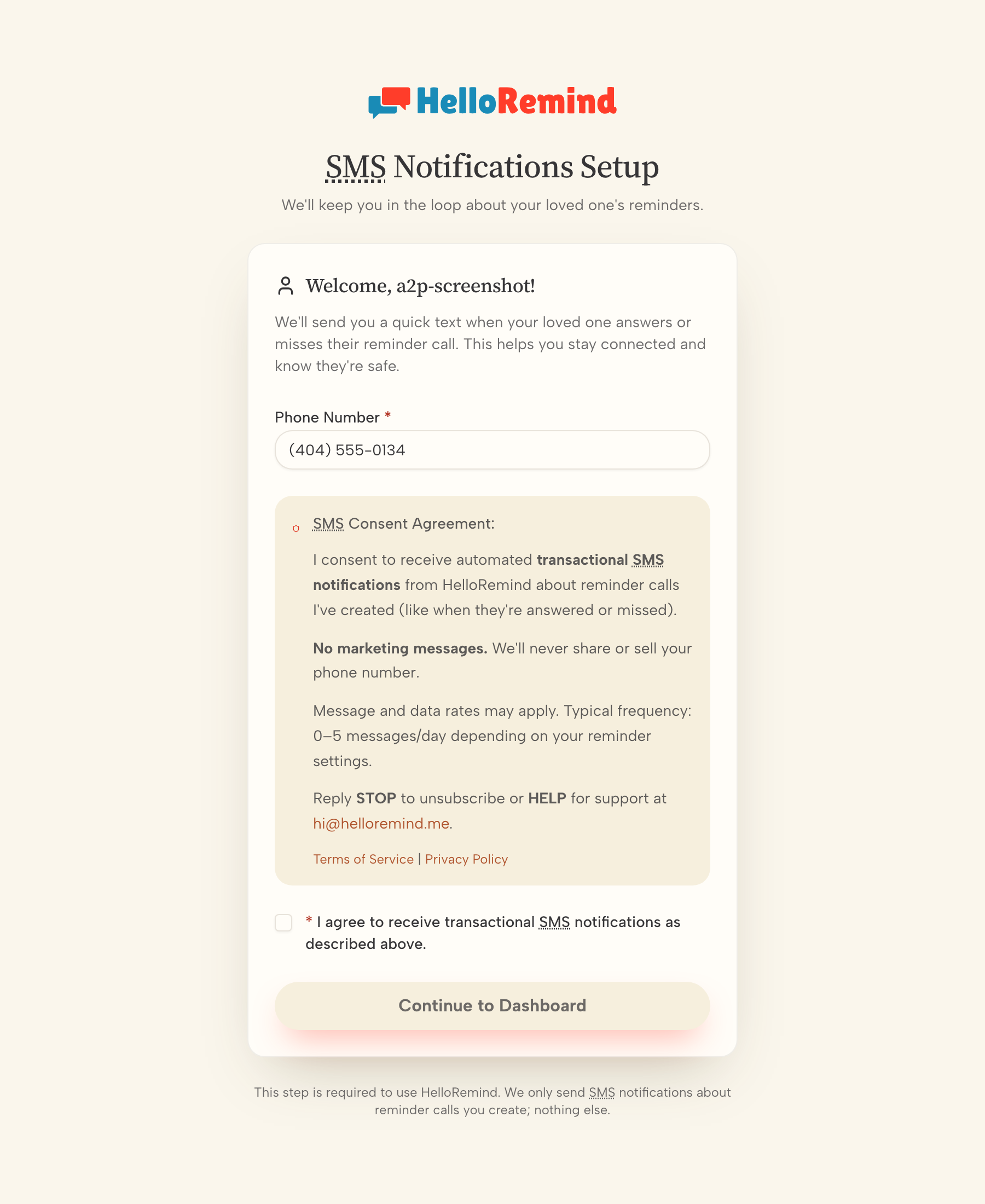
Consent is collected in the HelloRemind web app during onboarding, on a step titled “SMS Notifications Setup”, and again on the invitation screen when someone is invited to help care for a person on an existing account. In both places the caregiver enters their own mobile number and must tick a checkbox that is unchecked by default. Consent is never bundled into another agreement. Account holders must complete this separate step before entering the caregiver dashboard; consent is optional for invited caregivers and is never a condition of purchase.
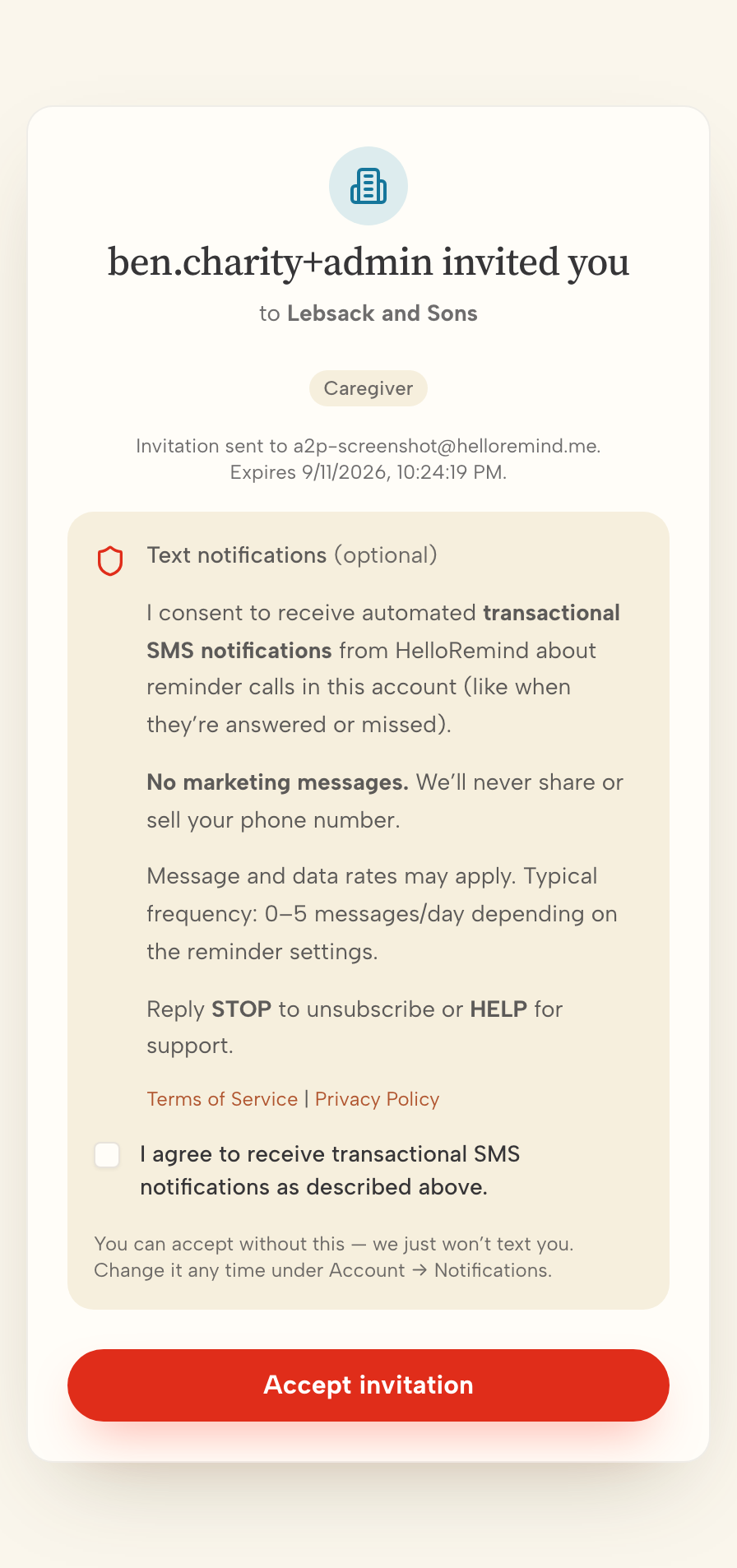
On the invitation screen it is explicitly optional: someone can accept an invitation without agreeing, and simply is not texted. An invited caregiver is asked in their own right rather than inheriting the consent of whoever invited them.
The checkbox reads:
I agree to receive transactional SMS notifications as described above.
Shown immediately above it, in full:
I consent to receive automated transactional SMS notifications from HelloRemind about reminder calls I have created (like when they are answered or missed). No marketing messages. We will never share or sell your phone number. Message and data rates may apply. Typical frequency: 0-5 messages/day depending on your reminder settings. Reply STOP to unsubscribe or HELP for support at hi[at]helloremind[dot]me. Terms of Service | Privacy Policy
On the invitation screen the first sentence reads “about reminder calls in this account” instead of “I’ve created”, because the invitee did not create them. The rest is identical.
A caregiver whose app is in Spanish sees the same step in Spanish, recorded as its own version of the wording. The checkbox reads:
Acepto recibir mensajes de texto transaccionales como se describe arriba.Shown immediately above it, in full:
Acepto recibir de HelloRemind mensajes de texto automatizados y transaccionales sobre las llamadas de recordatorio que he creado (por ejemplo, cuando se contestan o quedan sin confirmar). No enviamos mensajes publicitarios. Nunca compartiremos ni venderemos su número de teléfono. Pueden aplicarse tarifas de mensajes y datos. Frecuencia habitual: de 0 a 5 mensajes al día, según la configuración de sus recordatorios. Responda ALTO para cancelar o AYUDA para obtener ayuda en hi[at]helloremind[dot]me.On the invitation screen its first sentence reads “sobre las llamadas de recordatorio de esta cuenta” instead of “que he creado”. ALTO and AYUDA work as STOP and HELP do, and STOP and HELP keep working too.
The moment the box is ticked, we send one confirmation text so the caregiver knows it worked and so a mistyped number is caught before it receives anything else:
HelloRemind: You are set up for texts about the reminders you schedule. Msg frequency varies. Msg&data rates may apply. Reply HELP for help, STOP to cancel.
We store a timestamped record of each consent, including which version of the wording was shown, so a consent can always be matched to exactly what the person agreed to.
Phone verification codes. Separately from the consent above, an account holder confirms that a phone number is really theirs by asking for a one-time code, by phone call or by text, on the screen where they enter the number. A code is sent only when they press the button asking for it, one message per request, and only to the number they just entered. It is not a subscription and is not followed by any other message. A number that has replied STOP is never sent a code. The text reads:
HelloRemind: your code is 123456. It expires in 10 minutes. If you did not ask for this, ignore this message.
HelloRemind: su clave es 123456. Vence en 10 minutos. Si no la esperaba, ignore este mensaje.A recipient’s number is entered by their caregiver, not by the recipient. We treat that as insufficient on its own. A caregiver’s assertion is not the recipient’s consent, so we require both, in this order:
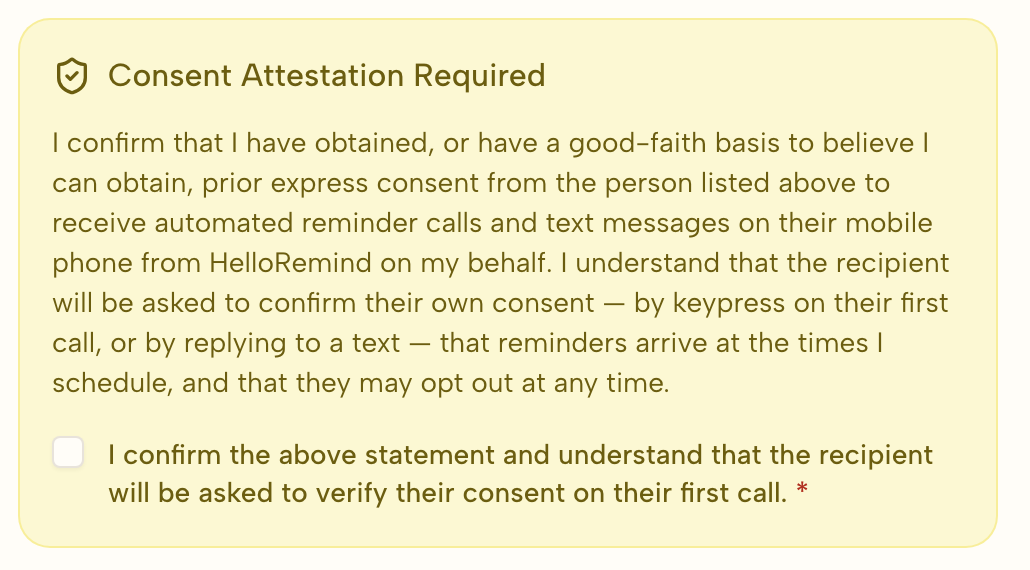
First, the caregiver attests. Before a recipient can be added, the caregiver must confirm:
I confirm that I have obtained, or have a good-faith basis to believe I can obtain, prior express consent from the person listed above to receive automated reminder calls and text messages on their mobile phone from HelloRemind on my behalf. I understand that the recipient will be asked to confirm their own consent — by keypress on their first call, or by replying to a text — that reminders arrive at the times I schedule, and that they may opt out at any time.
Second, and decisively, the recipient opts in themselves. Before any reminder text is sent, we send exactly one message asking for their consent. No reminder is ever delivered by text until they reply YES. That message reads:
HelloRemind: [Caregiver name] set up reminders for you. These arrive at the times they scheduled, which may include evenings or overnight. Reply YES to start receiving them, or STOP to decline. Msg&data rates may apply.
A recipient whose language is set to Spanish receives the same request in Spanish, with the same timing sentence and the same rates notice. It asks for the Spanish replies SI and ALTO; YES and STOP work just the same. It is worded to avoid the letters á, í, ó and ú, which are outside the standard SMS alphabet and would more than halve how much each message segment can hold.
HelloRemind: [Caregiver name] ha configurado recordatorios para usted. Llegan a las horas programadas, que pueden ser por la noche o de madrugada. Responda SI para recibirlos, o ALTO para rechazarlos. Pueden aplicarse tarifas de mensajes y datos.The caregiver is named in the message, so the recipient knows who added them and can recognise the request rather than guess at it. When they reply YES, they receive:
HelloRemind: You are now set up to receive reminders by text. Msg&data rates may apply. Reply HELP for help, STOP at any time to unsubscribe.
If they do not reply, we stop asking. We send the request at most three times, never more than once in any 24-hour period. After the third unanswered attempt the number is marked unreachable and we send it nothing further — not reminders, not another request. Silence is never treated as consent.
A caregiver may nominate someone to be alerted if a reminder is missed. That person never signed up for anything and may not know HelloRemind exists, so we do not take the caregiver’s word for it. When they are added, and before any alert is ever sent, we send them one message:
HelloRemind: [Caregiver name] added you as an emergency contact. We would only contact you if their loved one misses a reminder. Reply YES to agree, STOP to decline. Msg&data rates may apply.
A contact whose own language is set to Spanish receives it in Spanish:
HelloRemind: [Caregiver name] le ha agregado como contacto de respaldo de un ser querido. Solo le contactaremos si un recordatorio de esa persona queda sin confirmar. Responda SI para aceptar, o ALTO para rechazar. Pueden aplicarse tarifas de mensajes y datos.Nothing else is sent until they reply YES — no alert, and no phone call in its place. As with recipients, the request is sent at most three times, never more than once in 24 hours, and an unanswered third attempt marks the number unreachable. The caregiver is told, so they can nominate someone else.
When they reply YES, they receive:
HelloRemind: You will now get alerts by text when a reminder is missed. Msg&data rates may apply. Reply HELP for help, STOP to unsubscribe.
To a caregiver, about a reminder they set up:
A caregiver can also ask for a test text of a reminder they are writing, sent to their own number, which they have already verified and agreed to receive texts on:
To a recipient, as the reminder itself (the middle sentence is written by their caregiver):
To an escalation contact who has agreed:
Message frequency depends entirely on how many reminders the caregiver schedules — typically 0–5 messages a day. Message and data rates may apply.
Reply STOP to any message to opt out immediately. We also honour CANCEL, END, QUIT, UNSUBSCRIBE, REVOKE, STOPALL and OPTOUT, and in Spanish ALTO, PARAR, PARA, CANCELAR, BAJA and DETENER. You will receive one confirmation and nothing further:
You have been unsubscribed from HelloRemind reminders. No further messages will be sent. Reply START to resubscribe.
A recipient who replies STOP is opted out of both text messages and reminder phone calls, not just the channel the message arrived on. Someone asking to be left alone means it, and we do not make them say it twice.
Replying START clears an opt-out but does not by itself resume reminders — consent has to be given again. The reply reads:
You are resubscribed to HelloRemind reminders. Reply STOP at any time to unsubscribe.
A recipient who replies DONE or 1 to a reminder, and an escalation contact who replies OK to an alert, receives one short acknowledgement and nothing more:
Thanks - your reminder is marked as done.
Thank you for confirming. This alert has been acknowledged.
Reply HELP or INFO to any message and you will receive:
HelloRemind: reminder calls and texts for loved ones. Help: hi[at]helloremind[dot]me. Msg frequency varies. Msg&data rates may apply. Reply STOP to unsubscribe.
You can also email hi[at]helloremind[dot]me at any time. Caregivers can turn notifications off under Account → Notifications.
We keep a timestamped record of every consent and every opt-out, including the version of the wording shown at the time. Mobile numbers are encrypted at rest.
Mobile numbers, text-messaging opt-in data and consent records are never sold, rented, or shared with third parties or affiliates for marketing or promotional purposes. They are shared only with the telecommunications provider that delivers the message on our behalf, which is what makes delivery possible. See our Privacy Policy and Terms of Service.
Carriers are not liable for delayed or undelivered messages. HelloRemind is a convenience service, not an emergency service; in an emergency, call 911.